Volume Minimization¤
Suppose we want to find a suitable funicular geometry for a 5-meter span arch subjected to vertical point loads of 0.3 kN.
The arch has to be a compression-only structure.
We model the arch as a jax_fdm network built from a straight line of nodes evenly spaced along the span, joined edge to edge.
Then, we apply a force density of -1 to all of its edges, and compute the required shape with the force density method.
from jax_fdm.datastructures import FDNetwork
from jax_fdm.equilibrium import fdm


length = 5.0
num_segments = 10
segment_length = length / num_segments

xs = [-length / 2.0 + i * segment_length for i in range(num_segments + 1)]
nodes = [[x, 0.0, 0.0] for x in xs]
edges = [(i, i + 1) for i in range(num_segments)]

network = FDNetwork.from_nodes_and_edges(nodes, edges)
network.edges_forcedensities(q=-1.0)
network.nodes_supports(keys=[node for node in network.nodes() if network.is_leaf(node)])
network.nodes_loads([0.0, 0.0, -0.3])

f_network = fdm(network)
We now wish to find a new form for this arch that minimizes the total Michell's load path, while keeping the length of the arch segments between 0.75 and 1 meters. We solve this constrained form-finding problem with the SLSQP gradient-based optimizer.
from jax_fdm.equilibrium import constrained_fdm
from jax_fdm.optimization import SLSQP
from jax_fdm.constraints import EdgeLengthConstraint
from jax_fdm.goals import NetworkLoadPathGoal
from jax_fdm.losses import PredictionError
from jax_fdm.losses import Loss


loss = Loss(PredictionError(goals=[NetworkLoadPathGoal()]))
constraints = [EdgeLengthConstraint(edge, 0.75, 1.0) for edge in network.edges()]
optimizer = SLSQP()

c_network = constrained_fdm(network, optimizer, loss, constraints=constraints)
We finally visualize the constrained arch c_network with the Viewer, together with the unconstrained arch f_network as a plain wireframe (convert it to a COMPAS Network to draw it without the force density styling).
from compas.datastructures import Network
from jax_fdm.visualization import Viewer


viewer = Viewer(width=1600, height=900)
viewer.add(c_network)
viewer.add(f_network.copy(cls=Network))
viewer.show()
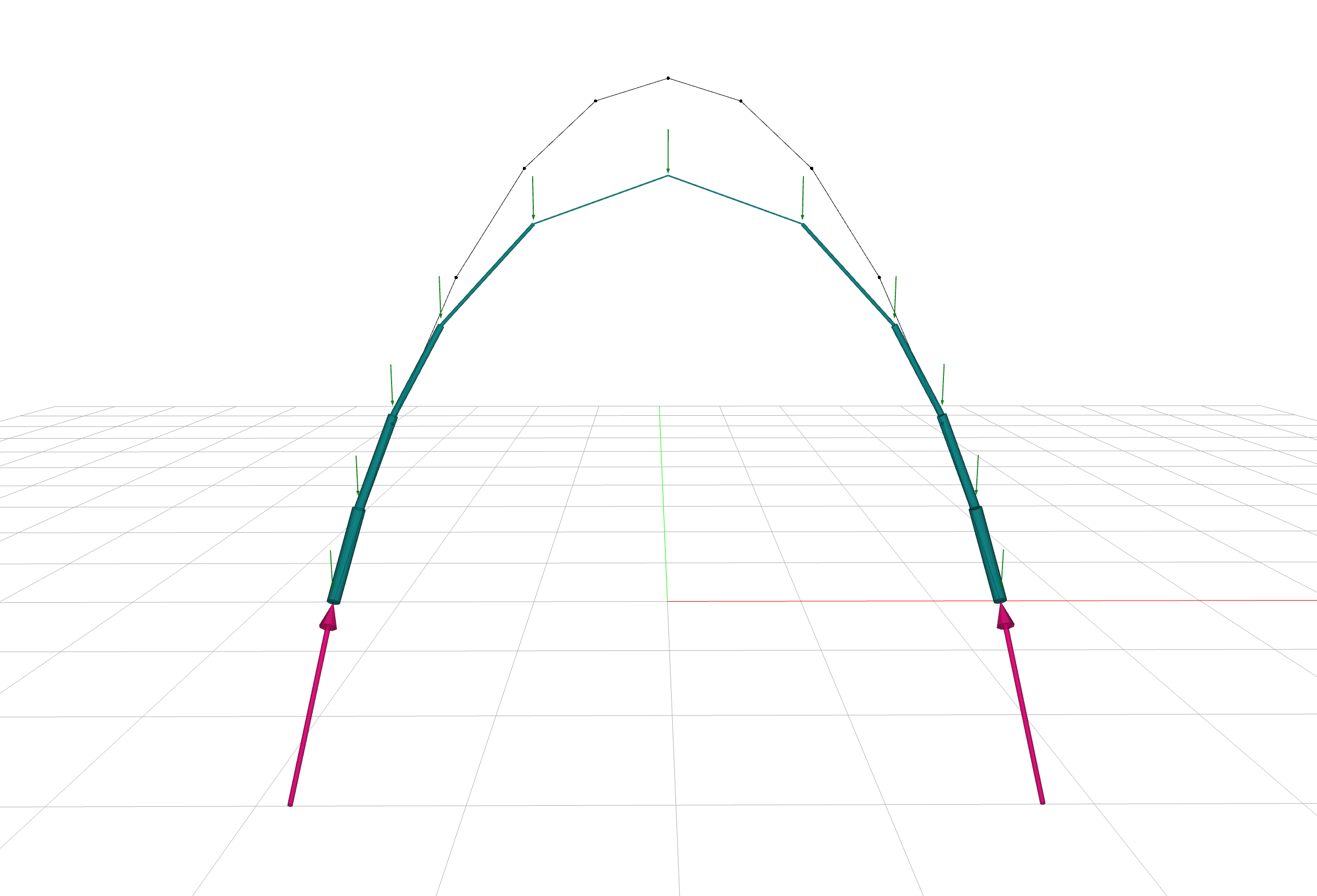
The constrained form is shallower than the unconstrained one as a result of the optimization process. The length of the arch segments also varies within the prescribed bounds to minimize the load path: segments are the longest where the arch's internal forces are lower (1.0 meter, at the apex), and conversely, the segments are shorter where the arch's internal forces are higher (0.75 m, at the base).